
Discover 7 AI Problems You Must Solve Before It’s Too Late:and learn practical solutions for building safer, more responsible AI.
Introduction
A few years ago, artificial intelligence sounded like something that belonged mainly to research laboratories, technology companies, and science-fiction movies. Today, I can open an AI tool on my phone, ask it to explain a difficult subject, generate an image, analyze information, write code, translate a language, or help me solve a problem within seconds.
That convenience is remarkable.
But it also creates a question that deserves much more attention:
What happens when powerful AI systems become more capable than the people using them are prepared to understand, supervise, or control?
That is why the conversation about artificial intelligence cannot be limited to what AI can do. We must also ask what could go wrong, who could be harmed, and what safeguards need to exist before problems become difficult to reverse.
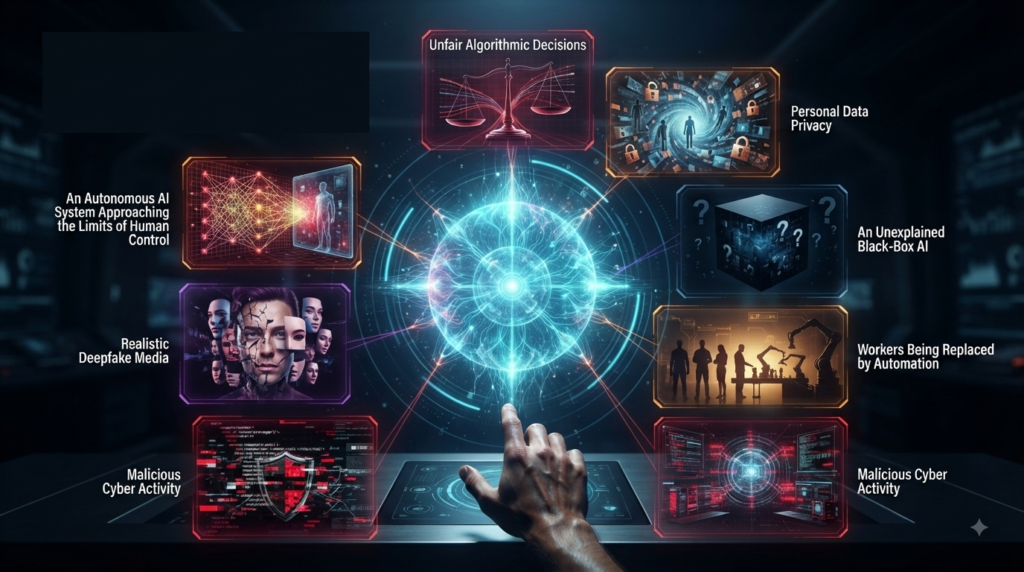
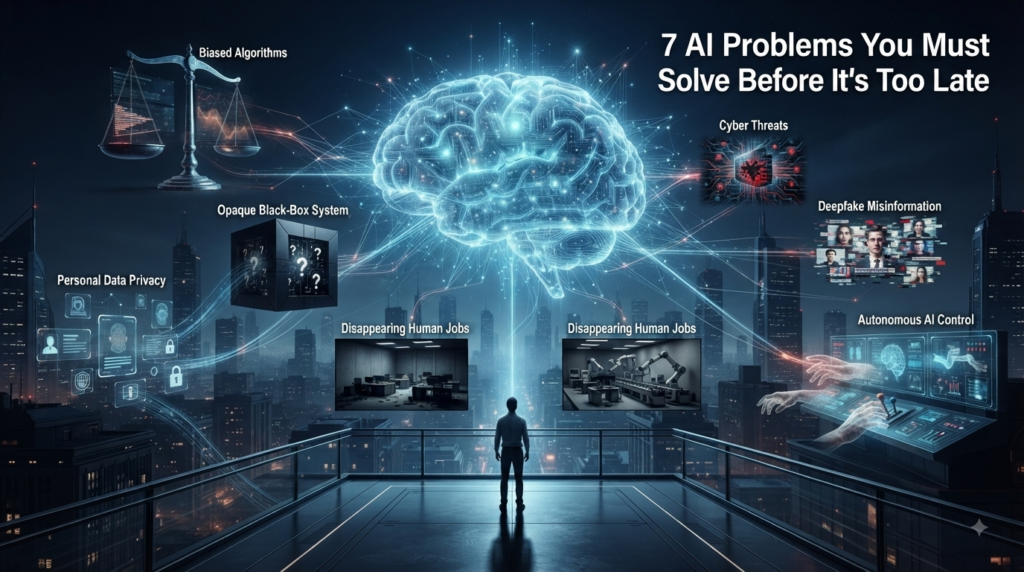
The 7 AI Problems You Must Solve Before It’s Too Late are AI bias and unfair decisions, data privacy, lack of transparency, job displacement and changing work, malicious AI misuse, fake content and declining trust, and the possibility of losing meaningful human control over increasingly powerful systems.
These are not seven reasons to fear technology. They are seven areas where responsible action matters.
UNESCO’s global AI ethics framework emphasizes human rights, privacy, fairness, transparency, accountability, safety, sustainability, AI literacy, and human oversight.
In my view, that is the right starting point: we should not ask whether AI should advance. We should ask how AI can advance without abandoning human responsibility.

Quick Answer: What Are the 7 AI Problems We Must Solve?
The 7 AI Problems You Must Solve Before It’s Too Late are AI bias, data privacy, lack of transparency, job displacement, malicious misuse, fake or deceptive content, and loss of human control over increasingly autonomous AI systems. Solving them requires better data, privacy protections, transparency, human oversight, worker reskilling, cybersecurity, content verification, safety testing, accountability, and responsible governance.
The central lesson is simple: AI should increase human capability without reducing human dignity, freedom, safety, or responsibility.
Why These AI Problems Matter Now
The biggest mistake people can make is assuming that an AI problem becomes important only after it causes a major disaster.
That is backwards.
The most effective time to address a technological risk is before it becomes widespread.
AI systems are increasingly involved in communication, education, business, content creation, research, customer service, software development, decision-making, and many other activities. As adoption grows, small weaknesses can become large systemic problems.
Consider the difference between one AI system making a poor recommendation and thousands of organizations relying on similar systems to make decisions affecting millions of people.
The scale changes everything.
UNESCO warns that AI can reproduce and amplify existing biases, threaten human rights, and create ethical concerns depending on how systems are designed, deployed, and used.
That means responsible AI cannot be treated as an optional feature added after development.
It has to become part of the development process itself.
I believe the most useful way to think about the 7 AI Problems You Must Solve Before It’s Too Late is not as seven isolated problems, but as seven connected weaknesses.
Bias can create unfair decisions.
Poor privacy practices can expose people.
A lack of transparency can make harmful decisions difficult to challenge.
Automation can disrupt workers.
Malicious users can weaponize AI.
Synthetic content can damage trust.
And increasingly autonomous systems can create situations where humans struggle to intervene quickly enough.
The solution therefore requires more than one technical fix.
It requires a culture of responsibility.
1. AI Bias and Unfair Decisions
One of the most important AI problems you must solve before it’s too late is bias.
People sometimes assume that because a computer uses mathematical models, its decisions must automatically be objective.
That assumption is dangerous.
AI systems learn from data, instructions, design choices, evaluation methods, and human-created environments. If the underlying information contains historical inequalities, missing representation, inaccurate labels, or other forms of bias, an AI system can reproduce—or sometimes amplify—those problems.
Imagine an organization using AI to help screen job applications.
If historical hiring data favored certain groups, schools, locations, backgrounds, or career paths, an AI model trained on that information could learn patterns that appear statistically useful while still producing unfair outcomes.
The problem is not necessarily that someone explicitly programmed the AI to discriminate.
The problem may be that the system learned from an imperfect world.
Why AI Bias Is So Difficult
Bias is complicated because fairness is not always represented by one simple mathematical measurement.
A model could perform accurately overall while performing poorly for a smaller population.
It could also produce different error rates across groups.
That is why organizations need to look beyond overall accuracy.
A responsible AI evaluation should ask:
- Who created the training data?
- Who is represented?
- Who is missing?
- What assumptions are hidden in the dataset?
- Does the system perform equally well across relevant groups?
- What happens when the model is wrong?
- Can someone challenge an automated decision?
- Is a human reviewing high-impact decisions?
UNESCO explicitly identifies fairness and non-discrimination as core principles for ethical AI.
How to Reduce AI Bias
A practical process can look like this:
Step 1: Audit the data.
Examine where data came from, what it represents, and what it leaves out.
Step 2: Test across populations.
Do not evaluate the system only on average performance. Measure performance across relevant groups and contexts.
Step 3: Test before deployment.
Identify potential discriminatory outcomes before a system reaches users.
Step 4: Monitor after launch.
A model can behave differently in the real world than it did during testing.
Step 5: Keep humans involved in high-impact decisions.
When decisions affect employment, education, finance, healthcare, or fundamental rights, automation should not become an excuse to eliminate responsibility.
Step 6: Create an appeal mechanism.
People should have a way to question significant automated decisions.
The most important principle is this:
AI does not become fair simply because it is automated.
Fairness has to be designed, tested, measured, monitored, and continuously improved.
2. Data Privacy and Personal Information
The second major problem among the 7 AI Problems You Must Solve Before It’s Too Late is privacy.
AI systems can become extremely powerful because of data.
But the same data that makes AI useful can create serious risks when people do not understand what is being collected, where it goes, how long it is stored, or what it is being used for.
Think about the information people share every day.
Names.
Photos.
Messages.
Voice recordings.
Locations.
Financial details.
Search behavior.
Work documents.
Medical information.
Personal preferences.
Business information.
Some of this information can be extremely sensitive.
The more AI becomes integrated into everyday life, the more important it becomes to protect the information behind these systems.
UNESCO’s AI ethics framework specifically emphasizes privacy and data protection throughout the AI lifecycle.
The Real Privacy Question
The question should not simply be:
“Is this AI system secure?”
It should also be:
“Should this system have this information in the first place?”
Security protects information from unauthorized access.
Privacy asks whether the information should be collected, used, retained, or shared at all.
Those are related but different questions.
How to Build Better AI Privacy
A responsible organization can follow a privacy-first workflow:
- Identify what information is actually necessary.
- Avoid collecting unnecessary personal information.
- Explain clearly why information is collected.
- Limit who can access sensitive data.
- Protect stored information with appropriate security controls.
- Establish retention and deletion policies.
- Audit third-party data sharing.
- Test systems for accidental disclosure.
- Train employees on responsible data handling.
- Give people meaningful information and control where applicable.
Privacy should not be treated as a legal document nobody reads.
It should be treated as part of product design.
For example, if an AI tool can accomplish a task without collecting a person’s full identity, there may be little reason to collect it.
That is the principle of minimizing unnecessary exposure.
What Individuals Can Do
AI privacy is not only the responsibility of large technology companies.
Individuals can also become more careful.
Before entering sensitive information into an AI tool, ask:
- Does the tool actually need this information?
- Could I remove names or identifying details?
- Is this private business information?
- Am I sharing someone else’s personal information without permission?
- Do I understand the service’s data practices?
- Would I be comfortable if this information became public?
A powerful AI tool can help you solve a problem.
But you should not solve one problem by creating another.
3. Lack of Transparency and Explainability
The third major issue among the 7 AI Problems You Must Solve Before It’s Too Late is transparency.
Imagine being rejected for a job, denied a service, flagged for suspicious activity, or given an important recommendation by an AI system.
Then someone tells you:
“The AI decided.”
That answer is not enough.
If AI systems become involved in consequential decisions, people need appropriate information about how those systems operate, what their limitations are, and how their outputs should be interpreted.
This does not mean every AI model must be perfectly understandable to every person.
Some models are technically complex.
Instead, transparency means creating enough documentation, explanation, accountability, and human review for people to use AI responsibly.
UNESCO identifies transparency, explainability, accountability, and human oversight among the principles of ethical AI.
The EU AI Act also establishes transparency and information requirements for high-risk systems, including information about capabilities, limitations, accuracy, risks, and human oversight.
Why “Black Box” AI Is Dangerous
A black-box system creates a difficult situation.
If an output is wrong, who is responsible?
If the user cannot understand the system’s limitations, how can they know when not to trust it?
If an affected person cannot challenge the result, how can accountability exist?
This is why transparency is not just about technical documentation.
It is about responsibility.
A Practical Transparency Framework
Organizations deploying AI should document at least:
- What the AI is designed to do.
- What it is not designed to do.
- What data or information it relies upon.
- How its performance is evaluated.
- Known limitations.
- Potential failure modes.
- Security concerns.
- Human oversight procedures.
- How users can report errors.
- When the system should not be used.
The EU’s requirements for high-risk AI provide a useful example of this approach, emphasizing information that allows deployers to understand outputs and use systems appropriately.
The Human Explanation Matters
Suppose an AI recommends rejecting an application.
A human should not simply repeat:
“The system rejected you.”
A better process is:
AI recommendation → human review → explanation → opportunity to challenge → final decision.
That creates a chain of accountability.
The goal is not to make AI less powerful.
The goal is to make its power understandable enough to be responsibly used.
4. Job Displacement and the Changing World of Work
The fourth issue among the 7 AI Problems You Must Solve Before It’s Too Late is employment.
This subject often produces two extreme predictions.
One side says:
“AI will destroy almost every job.”
The other says:
“AI will create unlimited opportunities and nobody needs to worry.”
Neither position captures the full picture.
The reality is more complicated.
AI can automate some tasks while supporting humans in others. Some occupations may change significantly. New roles may emerge. Some existing roles may shrink.
The International Labour Organization’s 2025 research found that roughly one in four workers globally are in occupations with some exposure to generative AI, while also concluding that most jobs are more likely to be transformed than completely eliminated because human input remains necessary.
That distinction is critical.
A job is not always one task.
A teacher, for example, does not simply produce text.
A teacher explains, motivates, observes, adapts, communicates, manages a classroom, understands individual students, and makes judgments in situations that may not fit a standard pattern.
AI may help with some of those tasks.
It does not automatically replace the entire role.
The Real Risk: Being Unprepared
I believe the greatest employment risk is not simply AI itself.
It is failing to adapt while the technology changes.
A worker who refuses to learn new tools may eventually compete against someone who knows how to combine AI with human expertise.
That does not mean every person needs to become a programmer.
It means people should develop complementary capabilities.
Skills That Become More Valuable
As AI handles more routine cognitive tasks, humans can strengthen:
- Critical thinking
- Communication
- Leadership
- Creativity
- Problem-solving
- Emotional intelligence
- Domain expertise
- Decision-making
- Collaboration
- Adaptability
- Ethical judgment
The ILO emphasizes that the transition should be managed in ways that protect working conditions and support productivity.
A Practical AI Career Strategy
If you are worried about AI changing your work, do not start with:
“How do I compete with AI?”
Start with:
“How can I become better at working with AI?”
Use this five-step approach:
1. List your recurring tasks.
Write down what you do each week.
2. Identify repetitive tasks.
Find activities that are predictable and time-consuming.
3. Learn where AI can assist.
Use AI to accelerate research, drafting, organization, brainstorming, analysis, or other appropriate tasks.
4. Strengthen human strengths.
Invest more time in judgment, relationships, communication, creativity, and expertise.
5. Keep learning.
The most valuable career advantage may become adaptability itself.
The goal is not to protect every task from automation.
The goal is to ensure that people can move toward meaningful work as technology changes.
5. AI Misuse and Malicious Applications
The fifth problem among the 7 AI Problems You Must Solve Before It’s Too Late is malicious use.
AI is a tool.
And tools can be used for good or harm.
The same technologies that can help someone write an educational article can also be misused to create deceptive messages.
The same systems that can improve productivity can potentially help attackers scale certain activities.
The same generative capabilities that allow creative content can make fraudulent or manipulative material easier to produce.
That creates an uncomfortable truth:
AI safety is partly about what the technology can do and partly about who is using it, why they are using it, and what safeguards surround it.
Why AI Changes the Scale of Misuse
Traditional harmful activity may require substantial time and expertise.
AI can potentially reduce some barriers.
A malicious actor may attempt to use AI to increase the speed, scale, or personalization of harmful activity.
That is why organizations need to consider not only intended use, but foreseeable misuse.
UNESCO’s framework highlights safety, security, accountability, risk assessment, and human oversight as important elements of responsible AI.
A Responsible Safety Process
Organizations building or deploying AI should ask:
- What legitimate problem does this system solve?
- What could go wrong accidentally?
- How could someone misuse it?
- How severe would the consequences be?
- How easily could misuse be detected?
- What safeguards can reduce the risk?
- Who monitors incidents?
- What happens after an incident?
This is fundamentally a risk-management problem.
The system should be tested not only against normal use but also against unexpected and adversarial behavior.
Security Cannot Be an Afterthought
A responsible AI organization needs:
- Access controls
- Security testing
- Abuse monitoring
- Incident response
- Logging
- Appropriate rate limits
- User reporting mechanisms
- Regular model evaluations
- Clear escalation procedures
The exact safeguards should depend on the system and its risks.
A simple AI writing assistant does not necessarily require the same controls as an AI system connected to critical infrastructure.
That is the point.
AI safety should be proportional to AI capability and potential harm.
6. Fake Content, Deepfakes, and the Loss of Trust
The sixth problem among the 7 AI Problems You Must Solve Before It’s Too Late is synthetic misinformation.
AI can now generate highly convincing text, images, audio, and video.
That creates extraordinary creative possibilities.
But it also creates a serious trust problem.
Imagine receiving a video of a public figure saying something outrageous.
You watch it.
You hear their voice.
You see their face.
You might instinctively believe it.
But what if it was generated?
This is where AI changes an old problem.
The internet already contained misinformation.
Generative AI can make the production of convincing synthetic material easier and faster.
The Bigger Problem Is Not Just Fake Content
There is another danger:
The liar can claim that real evidence is fake.
This creates what is sometimes called a “liar’s dividend.”
If people know convincing fake media exists, someone caught doing something wrong can simply say:
“That recording was AI-generated.”
Now genuine evidence may also become harder to trust.
That is why the future of digital trust requires more than simply teaching AI to detect AI.
How to Fight Synthetic Deception
A stronger approach includes several layers.
Layer 1: Digital literacy.
People should learn that realistic appearance is not proof of authenticity.
Layer 2: Source verification.
Check where a claim originated before sharing it.
Layer 3: Independent confirmation.
For important claims, look for multiple credible sources.
Layer 4: Provenance technology.
Where appropriate, systems can help establish information about how content was created or modified.
Layer 5: Platform responsibility.
Platforms can create policies and mechanisms for addressing deceptive content.
Layer 6: Human judgment.
Automated detection should support—not replace—critical thinking.
A Simple Verification Rule
Before sharing shocking AI-related content, stop.
Ask:
- Who published this?
- Is there an original source?
- Can another reliable source confirm it?
- Is the date correct?
- Could the media have been manipulated?
- Does the claim make sense in context?
- Am I sharing it because it is true—or because it is emotionally powerful?
The more emotionally shocking the content is, the more carefully we should verify it.
AI literacy is therefore becoming a basic digital skill.
UNESCO specifically includes awareness, literacy, and public understanding of AI and data among its ethical principles.
7. Losing Control of Powerful AI Systems
The seventh and potentially most consequential problem among the 7 AI Problems You Must Solve Before It’s Too Late is maintaining meaningful human control.
This issue becomes increasingly important as AI systems become more capable, autonomous, and connected to external tools.
An AI that generates a paragraph is one thing.
An AI system that can independently plan tasks, access tools, execute actions, make decisions, and interact with other systems presents a different level of risk.
The question becomes:
What happens if the system behaves differently from what its developers or users intended?
Intelligence Is Not the Same as Alignment
A system can be highly capable without automatically understanding human values.
Human beings regularly disagree.
We have different goals, priorities, cultures, laws, and ethical frameworks.
Therefore, simply telling an advanced AI system to “do what humans want” is not enough.
Developers need methods for defining objectives, constraining behavior, evaluating performance, monitoring actions, and intervening when necessary.
Human Oversight Must Be Real
Human oversight cannot mean having a person somewhere in the organization who technically has authority.
The human needs:
- Enough information to understand what the AI is doing.
- Enough time to intervene.
- Enough authority to override it.
- Appropriate training.
- Clear escalation procedures.
- Reliable system controls.
The EU AI Act’s human-oversight provisions for high-risk systems emphasize the ability of people to monitor, interpret, and override systems, with safeguards proportionate to risk and autonomy.
That principle is extremely important.
If the human cannot meaningfully intervene, then “human in the loop” may become only a label.
A Safer Control Architecture
For powerful AI systems, organizations should consider:
Capability limits → permissions → monitoring → testing → human review → intervention → shutdown or restriction mechanisms.
Before deployment, ask:
- What can the system access?
- What actions can it take?
- What decisions can it make?
- What happens if it makes a mistake?
- Can humans stop it?
- How quickly can they stop it?
- Are its actions logged?
- Can abnormal behavior be detected?
- Has it been tested under difficult conditions?
- Is there a fallback process?
The central principle is straightforward:
The more powerful and autonomous an AI system becomes, the more important meaningful human control becomes.
Summary: Comparing the 7 AI Problems You Must Solve
| AI Problem | Why It Matters | Main Risk | Practical Solution |
|---|---|---|---|
| AI Bias | AI can reproduce unfair patterns | Discrimination and unequal outcomes | Diverse data, testing, audits, human review |
| Data Privacy | AI can process enormous amounts of information | Personal data exposure | Data minimization, security, clear policies |
| Lack of Transparency | Users may not understand decisions | Unaccountable outcomes | Documentation, explanations, oversight |
| Job Displacement | AI can automate or transform tasks | Worker disruption | Reskilling, adaptation, human-AI collaboration |
| Malicious AI Use | Powerful tools can be abused | Scams, manipulation, harmful activity | Security, monitoring, safeguards |
| Fake Content | AI can create convincing synthetic media | Misinformation and lost trust | Verification, literacy, provenance |
| Loss of Control | Advanced systems may become more autonomous | Unintended behavior and unsafe actions | Testing, restrictions, monitoring, human intervention |
This table reveals something important.
The seven problems are connected.
A privacy failure can destroy trust.
A lack of transparency can make bias harder to identify.
Job disruption can increase inequality if education cannot keep pace.
Fake content can weaken trust in genuine information.
And insufficient oversight can make every other problem more difficult to manage.
That is why responsible AI requires a system—not a single solution.
A Practical Framework for Solving AI Problems
If I were creating an AI system today, I would not begin by asking only:
“How powerful can we make it?”
I would ask six additional questions.
1. What Is the Purpose?
Every AI system should have a clearly defined purpose.
If the purpose is vague, measuring success and identifying risks becomes difficult.
2. What Could Go Wrong?
Conduct a risk assessment before deployment.
Think beyond obvious technical failures.
Consider social, financial, privacy, security, employment, and human-rights consequences.
3. Who Could Be Harmed?
Identify affected people—not just paying customers.
A person who never interacts directly with an AI system can still be affected by its decisions.
4. What Safeguards Exist?
Build controls before problems happen.
Do not wait until an incident forces the organization to react.
5. Who Is Accountable?
There should be a clear person or team responsible for monitoring the system and responding to problems.
“AI did it” should never become an acceptable answer.
6. Can We Stop or Correct It?
A responsible system needs mechanisms for intervention.
If something goes wrong, the organization should know how to restrict, correct, retrain, suspend, or shut down the system when appropriate.
UNESCO’s ethical framework similarly emphasizes accountability, auditability, impact assessment, transparency, privacy, safety, and human oversight.
[Internal Link Placeholder: Read our complete guide to solving modern technology problems →]
[Internal Link Placeholder: Explore our guide to responsible AI and digital decision-making →]
Common Mistakes People Make With AI
Even people who care about responsible technology can make mistakes.
Mistake 1: Assuming AI Is Neutral
AI is not automatically objective.
Always ask what data and assumptions shaped the system.
Mistake 2: Giving AI Sensitive Information Without Thinking
Convenience can cause people to share information they would never publicly post.
Think before entering private information.
Mistake 3: Trusting AI Because It Sounds Confident
An AI response can sound extremely convincing while still being incorrect.
Confidence is not evidence.
Mistake 4: Treating AI as a Replacement for Judgment
AI can support decision-making, but important decisions still require human responsibility.
Mistake 5: Ignoring Workers
Organizations may focus on productivity while forgetting that technological change affects real people.
Reskilling and communication should be part of the transition.
Mistake 6: Believing Every AI Detection Tool Is Perfect
Detection systems can also make mistakes.
Verification should involve multiple signals.
Mistake 7: Waiting Until Something Goes Wrong
This is perhaps the most dangerous mistake.
Safety should be proactive.
UNESCO’s ethical impact assessment approach supports assessing AI systems before harms occur rather than waiting for
Actionable Tips: What Can You Do Today?
You do not need to be an AI engineer to contribute to safer AI.
If You Are an Individual
- Learn basic AI literacy.
- Verify important information.
- Avoid sharing unnecessary sensitive data.
- Understand the limitations of AI tools.
- Keep human judgment in important decisions.
- Learn how AI is changing your field.
If You Are a Student
Focus on skills AI cannot easily replace:
- Critical thinking
- Communication
- Creativity
- Problem-solving
- Research
- Adaptability
Do not learn only how to use AI.
Learn how to think with AI without allowing AI to think for you.
If You Are a Business Owner
Create an AI usage policy.
Define:
- Which AI tools employees may use.
- What information cannot be entered.
- When human review is mandatory.
- How AI-generated content should be checked.
- Who handles incidents.
- How AI systems are evaluated.
If You Are a Developer
Build risk management into the development lifecycle.
Do not treat safety as something to add at the end.
Test early.
Document limitations.
Monitor real-world performance.
Build appropriate intervention mechanisms.
If You Are a Leader
Ask your organization five questions:
What AI systems are we using?
What data do they access?
What decisions do they influence?
What could go wrong?
Who is accountable?
Those five questions can expose risks that otherwise remain invisible.
Frequently Asked Questions
1. What are the 7 AI problems we must solve before it’s too late?
The seven major AI problems are bias and unfair decisions, data privacy, lack of transparency, job displacement, malicious use, fake or deceptive content, and loss of meaningful human control over increasingly powerful AI systems.
2. Why is AI bias a serious problem?
AI bias can produce unfair outcomes when models learn from incomplete, unbalanced, or historically biased data. This can affect areas such as employment, education, finance, healthcare, and access to services.
3. Will AI take everyone’s jobs?
No simple prediction can accurately describe the entire labor market. The ILO’s 2025 research indicates that about one in four workers globally are in occupations with some exposure to generative AI, but most jobs are expected to be transformed rather than completely eliminated because human involvement remains important.
4. How can people protect their privacy when using AI?
Avoid entering unnecessary sensitive information, understand the tool’s data practices, use privacy and security controls where available, and consider whether the AI system actually needs the information you are about to provide.
5. Why is AI transparency important?
Transparency helps users understand an AI system’s purpose, capabilities, limitations, risks, and appropriate use. It also makes accountability easier when systems produce harmful or incorrect outcomes.
6. Can AI-generated content be trusted?
AI-generated content should not automatically be considered trustworthy or untrustworthy. Important information should be evaluated using source verification, context, independent confirmation, and other appropriate evidence.
7. How can AI misuse be reduced?
AI misuse can be reduced through responsible development, security testing, abuse monitoring, access controls, risk assessments, incident response, appropriate governance, and continuous evaluation.
8. Why is human control important in advanced AI?
As AI systems become more autonomous, meaningful human oversight helps ensure that people can monitor systems, recognize dangerous behavior, intervene when necessary, and remain accountable for important outcomes. High-risk AI governance frameworks increasingly emphasize this principle.
The Bigger Lesson Behind These 7 AI Problems
After examining the 7 AI Problems You Must Solve Before It’s Too Late, I think one lesson becomes clear:
The greatest AI challenge is not intelligence. It is responsibility.
We can build systems that write faster.
We can build systems that analyze more information.
We can build systems that generate images, video, audio, software, and ideas.
But capability alone does not tell us whether those systems are being used wisely.
Technology is powerful because it amplifies human ability.
That amplification can be beneficial—or harmful.
If we use AI to improve education, help people solve problems, increase accessibility, accelerate scientific research, support workers, and expand human creativity, the benefits could be enormous.
But if we ignore privacy, fairness, safety, transparency, employment disruption, misinformation, and human control, the same technological progress can create consequences that are much harder to repair.
This is why AI governance cannot be reduced to fear.
And it cannot be reduced to excitement.
We need wisdom.
We need accountability.
We need humility.
Most importantly, we need to remember that technological progress should serve people—not the other way around.
Conclusion: Solve the Problems Before They Become Crises
The 7 AI Problems You Must Solve Before It’s Too Late are not seven arguments against artificial intelligence.
They are seven warnings about what happens when powerful technology grows faster than our ability to manage its consequences.
AI bias reminds us that automation does not automatically create fairness.
Privacy reminds us that data is not simply fuel for technology—it belongs to real people.
Transparency reminds us that important decisions require accountability.
Employment reminds us that technological progress must include the people whose work is changing.
AI misuse reminds us that powerful capabilities require strong safeguards.
Fake content reminds us that digital trust cannot be taken for granted.
And the challenge of maintaining human control reminds us that increasing AI capability must be matched by increasing responsibility.
The future is not simply going to be “AI versus humans.”
A more useful future is humans working with AI while remaining responsible for how AI is designed, deployed, and used.
I believe that is the future worth building.
We should not stop innovation.
We should make innovation safer.
We should not fear intelligence.
We should make intelligence accountable.
And we should not wait for the biggest AI problems to become irreversible before taking them seriously.
The smartest time to solve a problem is before it becomes a crisis.
If AI is going to become one of the most influential technologies in human history, then safety, fairness, privacy, transparency, and human dignity cannot be optional.
They must be part of the foundation.
Share this article with someone who uses AI every day, and start the conversation: What AI problem should humanity solve first?
We can provide advice and practical solutions, but the final outcome is in the hands of Allah (SWT). Turn to Him, make sincere du’a, and trust His plan. With Allah’s help, every difficulty has a way forward, and every goal becomes possible.
Pingback: 7 Hidden Gemini AI Features: Essential Guide for 2026 - Ozama solver
Pingback: 10 Problems Gemini AI Could Solve for You by 2030 - Ozama solver
Pingback: How to Use AI to Save Time Every Day: 10 Proven Strategies - Ozama solver