
Discover 10 problems Gemini AI could solve by 2030, from information overload and learning to health, research, transport, energy, and waste.
Introduction
I have watched AI change from a tool that could answer simple questions into something capable of writing, analyzing information, creating images, translating languages, and assisting with complicated tasks. What interests me most, however, is not what AI can do today. It is what systems such as Gemini might realistically help ordinary people solve by 2030.
Imagine starting your morning with thousands of pieces of information competing for your attention. Your emails need replies, your calendar is full, a report needs analysis, you need to learn something new, and you have several personal decisions to make. Instead of spending hours organizing everything yourself, an advanced AI assistant could potentially understand your priorities and help coordinate the work.
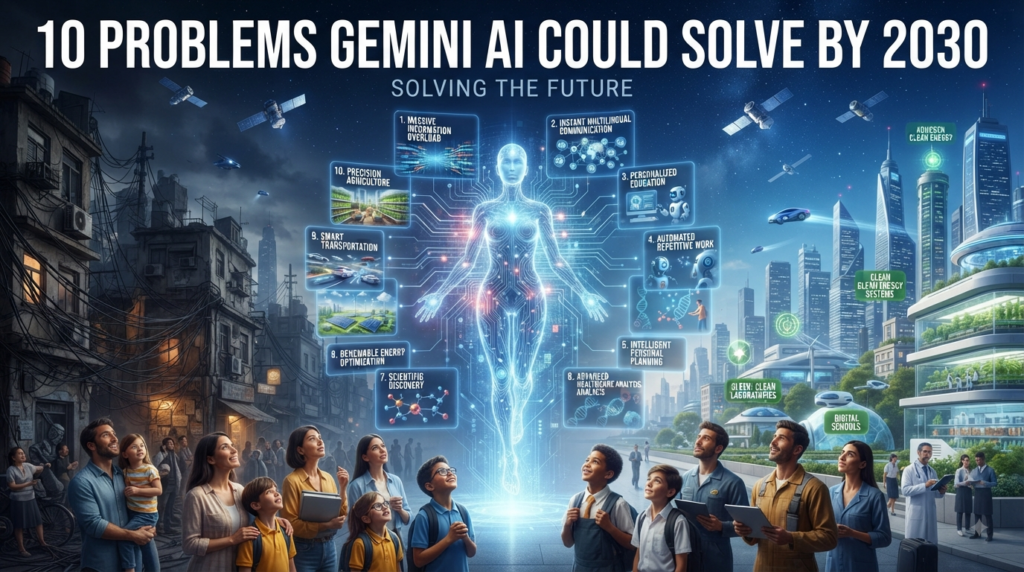
Quick answer: By 2030, 10 Problems Gemini AI Could Solve for You by 2030 could include information overload, language barriers, personalized education, repetitive work, personal planning, earlier health-risk detection, scientific research, energy management, transportation, and food/resource waste. These possibilities depend on continued advances in AI, reliable data, safety, privacy, regulation, and human oversight.
That distinction matters.
I am not presenting these possibilities as guaranteed predictions. Technology can develop differently from what we expect. Some capabilities may arrive earlier, some later, and some may remain difficult for technical, economic, ethical, or regulatory reasons.
The useful question is therefore not, “Will Gemini definitely do all of this?”
The better question is:
What problems could increasingly capable AI systems help humans solve by 2030—and what would responsible use look like?
That is the question I explore here.
Important note: This article discusses potential future capabilities, not promises about Google’s products. Any health, financial, legal, or other high-stakes decision should continue to involve an appropriately qualified professional.
1. Information Overload Could Become a Manageable Problem
Information is one of the biggest hidden problems of modern life.
We have more access to information than any previous generation, yet access does not automatically produce understanding. A person can receive hundreds of emails, messages, reports, notifications, documents, videos, articles, and social-media updates every day and still struggle to determine what actually matters.
This is where 10 Problems Gemini AI Could Solve for You by 2030 becomes particularly interesting.
An increasingly capable AI assistant could potentially act as an information filter rather than simply another search box.
Instead of asking, “What does this document say?” you could potentially ask:
“Read these documents, identify the three issues that require my attention, explain why they matter, and separate urgent decisions from information I can ignore for now.”
That is a fundamentally different experience.
How the workflow could work
Imagine uploading or connecting several legitimate sources of information.
The AI could potentially:
- Read and categorize the material.
- Identify repeated themes.
- Detect contradictions.
- Extract deadlines and responsibilities.
- Rank information according to your priorities.
- Produce a short explanation.
- Link each conclusion back to the original source.
- Ask for human confirmation before taking consequential action.
The last point is critical.
A powerful AI that summarizes incorrectly can create a powerful version of an old problem. The future of information management therefore cannot simply be “AI reads everything.” It needs to be AI reads, verifies, explains, cites, and knows when it is uncertain.
For ordinary users, this could mean less time searching and more time understanding.
For professionals, it could mean reducing the hours spent manually reviewing documents.
For researchers, it could mean quickly identifying relevant studies.
For students, it could mean transforming large collections of educational material into understandable study guides.
The potential benefit is not merely speed.
It is attention recovery.
Your attention is limited. If AI can safely handle low-value information processing, you may have more mental capacity for decisions that genuinely require human judgment.
Possible future outcome: Instead of drowning in information, people could have AI organize information according to context, urgency, reliability, and personal goals.
2. Language Barriers Could Become Less Powerful
Language is one of humanity’s greatest tools—and one of its biggest barriers.
A person may have brilliant ideas but struggle to communicate them because they do not speak another person’s language. Businesses lose opportunities because customers cannot communicate easily. Students encounter educational material they cannot fully understand. Families separated across language barriers can struggle to express subtle emotions.
AI translation is already useful, but the future could be significantly more sophisticated.
One of the most interesting possibilities among 10 Problems Gemini AI Could Solve for You by 2030 is real-time communication that goes beyond translating individual words.
Translation could become contextual
Human communication involves more than vocabulary.
Meaning depends on:
- Tone
- Cultural context
- Formality
- Humor
- Idioms
- Emotion
- Intention
- Situation
A literal translation can be grammatically correct while still sounding completely unnatural.
By 2030, advanced AI could potentially provide more context-aware translation across conversations, meetings, documents, educational materials, and digital communication.
Imagine two people speaking different languages during a video call.
Rather than waiting for one person to finish, an AI system could potentially:
Person A → AI understands speech → translates meaning → Person B hears it in their language
The reverse could happen simultaneously.
That could make multilingual communication feel much more natural.
Why this matters
The biggest impact may happen outside technology companies.
A teacher could communicate with parents who speak another language.
A small business could communicate with international customers.
A student could access educational resources written in another language.
A traveler could communicate more confidently in unfamiliar environments.
However, translation must remain cautious around sensitive subjects. Legal documents, medical instructions, contracts, and official communications can require professional human review.
The future should not be “AI replaces translators.”
It could instead become:
AI handles speed and scale while humans handle high-stakes accuracy, cultural judgment, and accountability.
That is a much more realistic and responsible vision.
Possible future outcome: Language may become less of a technical barrier, allowing more people to communicate, learn, collaborate, and participate globally.
3. Personal Learning Could Become More Effective
Education has traditionally been designed around groups.
A classroom might have 30 students, one teacher, one curriculum, one textbook, and one pace. But students do not learn identically.
One student understands mathematics quickly but struggles with reading. Another understands written explanations but needs visual examples. A third may need ten repetitions before a concept becomes clear.
This is why personalized learning could become one of the most valuable possibilities in 10 Problems Gemini AI Could Solve for You by 2030.
AI could adapt to the learner
Instead of giving every student exactly the same explanation, an advanced AI tutor could potentially identify:
- What the student already understands
- Where the student is struggling
- Which mistakes they repeatedly make
- What explanation style works best
- How quickly they are progressing
- Which concepts need revision
Then it could adapt.
Suppose a student asks:
“Explain photosynthesis.”
The first explanation might be simple.
If the student still does not understand, AI could try a story.
If that fails, it could use an analogy.
If the learner prefers visuals, it could create a diagram.
If the student understands the basic concept but struggles with the scientific terminology, the AI could focus specifically on vocabulary.
That creates a learning loop:
Explain → Test → Identify weakness → Adapt → Practice → Re-test
A possible 2030 learning workflow
A student could potentially tell Gemini:
“Teach me this subject for 30 days. Start by testing what I know. Create a daily lesson, give me exercises, track my mistakes, and make tomorrow’s lesson based on today’s performance.”
That would be more than a chatbot.
It would be a personalized learning system.
Still, teachers would remain essential.
A teacher provides mentorship, emotional support, discipline, social development, classroom interaction, and professional judgment. AI can potentially increase a teacher’s reach without replacing the human relationship at the center of education.
For learners outside formal schools, the potential is even larger.
Someone with an internet connection could potentially receive individualized explanations that previously required expensive tutoring.
Possible future outcome: Education could move from “everyone learns the same lesson” toward “everyone receives support appropriate to their needs.”
4. Repetitive Digital Work Could Consume Less Human Time
Many jobs contain tasks that are important but repetitive.
People copy information from one system to another. They organize spreadsheets. Sort messages. Prepare recurring reports. Schedule meetings. Format documents. Categorize requests. Check routine data.
None of these tasks necessarily requires human creativity every time.
That makes automation one of the most practical possibilities among 10 Problems Gemini AI Could Solve for You by 2030.
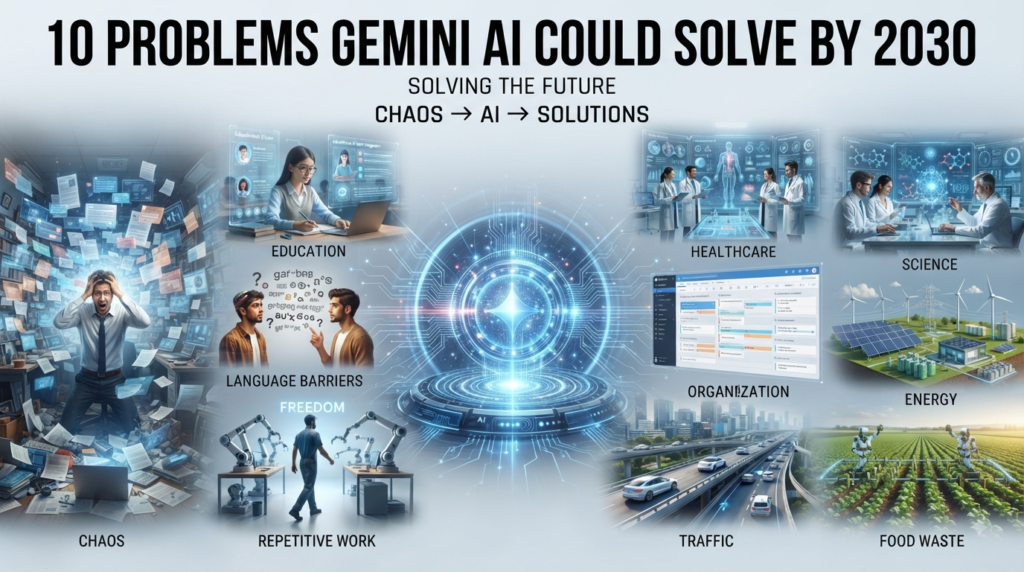
From chatbot to AI agent
Today’s AI assistants often wait for instructions.
A more capable AI agent could potentially work through a multi-step process.
For example:
Task: Prepare a weekly business report.
The system could potentially:
- Collect authorized data.
- Clean the information.
- Compare it with previous weeks.
- Identify unusual changes.
- Create charts.
- Draft an explanation.
- Highlight problems.
- Prepare a report.
- Ask the human to review it.
- Send it only after approval.
That is very different from simply asking AI to “write a report.”
The AI would be participating in a workflow.
The human role changes
Automation does not necessarily mean humans become irrelevant.
Instead, human work may shift toward:
- Defining goals
- Reviewing outcomes
- Making difficult decisions
- Building relationships
- Creating strategies
- Handling exceptions
- Taking responsibility
The danger is assuming that automation is always beneficial.
If an AI system makes an error at scale, automation can multiply the problem. Businesses therefore need permissions, audit logs, human approvals, security controls, and clear accountability.
Possible future outcome: People could spend less time on repetitive digital administration and more time on tasks requiring judgment, creativity, communication, and leadership.
5. Smarter Personal Planning Could Reduce Everyday Friction
Life contains hundreds of tiny decisions.
When is the appointment?
What should I prepare?
What do I need to buy?
How long will the journey take?
Which tasks are urgent?
What happens if my schedule changes?
A basic digital assistant can remind you about something. A more capable AI could potentially understand how different tasks affect one another.
That makes personal planning another major possibility in 10 Problems Gemini AI Could Solve for You by 2030.
Imagine this scenario
You tell your AI:
“I have a meeting tomorrow at 10 a.m. It takes 45 minutes to travel there. I need to prepare a presentation, print documents, and buy something on the way.”
Instead of creating one reminder, the system could potentially organize a sequence:
Today
- Finish presentation
- Review documents
Tomorrow morning
- Print documents
- Leave at an appropriate time
- Stop at the required location
- Arrive before the meeting
If traffic changes, the plan could potentially adapt.
If the meeting moves, the schedule could update.
If a task remains unfinished, the system could recommend a new time.
The important difference
The future assistant may not simply manage a calendar.
It could potentially manage dependencies between tasks.
That means understanding that:
Task A must happen before Task B, and Task B affects Task C.
This is much closer to personal project management.
It could also help people avoid cognitive overload by turning vague goals into specific next actions.
For example:
Goal: “I want to start learning SEO.”
AI could potentially transform that into:
- Learn search intent.
- Study keyword research.
- Practice writing titles.
- Learn internal linking.
- Publish a small article.
- Review performance.
- Improve the next article.
The AI does not accomplish the goal for you.
It makes the path clearer.
Possible future outcome: AI could reduce the mental burden of coordinating everyday responsibilities and turn complicated intentions into manageable sequences.
6. Earlier Health Detection Could Support Medical Professionals
Health is one of the areas where AI’s potential is enormous—and where caution is absolutely necessary.
Advanced AI systems could potentially analyze large quantities of medical information faster than humans can manually process it. This could include medical images, laboratory results, patient histories, scientific literature, and other authorized health information.
That makes earlier detection one of the most important possibilities in 10 Problems Gemini AI Could Solve for You by 2030.
What could AI potentially do?
AI might help clinicians:
- Detect patterns in medical images
- Compare patient data with relevant research
- Identify unusual changes
- Flag information that deserves review
- Organize medical records
- Summarize patient histories
- Support clinical decision-making
The important word is support.
AI should not automatically become the final authority over someone’s health.
A medical professional needs to consider the patient’s complete circumstances, limitations of the available data, clinical experience, risks, and other factors that an AI system may not fully understand.
Why early detection matters
Many health problems become more difficult when discovered late.
If AI can responsibly help professionals notice a potential warning sign earlier, it could give clinicians an opportunity to investigate it sooner.
But this area has a major danger: false confidence.
An AI system can produce an impressive explanation and still be wrong.
That means healthcare AI needs rigorous testing, validation, privacy protection, clinical oversight, and clear boundaries.
For users, the rule should remain simple:
AI information is not a substitute for professional medical diagnosis or treatment.
Possible future outcome: AI could help healthcare professionals process complex information more efficiently and potentially identify certain warning patterns earlier, while humans remain responsible for clinical judgment.
7. Scientific Research Could Move Faster
Scientific discovery often requires enormous amounts of information.
Researchers may spend years reading studies, analyzing datasets, designing experiments, comparing results, and testing hypotheses.
AI could potentially accelerate some of these processes.
Among 10 Problems Gemini AI Could Solve for You by 2030, faster research may have one of the greatest long-term effects because scientific progress influences medicine, energy, agriculture, engineering, and many other fields.
AI as a research assistant
A future system could potentially help a researcher:
- Search relevant scientific literature.
- Organize thousands of papers.
- Compare conflicting findings.
- Identify gaps in existing research.
- Suggest possible hypotheses.
- Analyze datasets.
- Simulate certain scenarios.
- Help design experiments.
- Generate preliminary reports.
- Identify questions requiring human investigation.
This could reduce the amount of time researchers spend on information management.
The most exciting possibility: finding connections
Science sometimes advances when someone notices a relationship between things that previously seemed unrelated.
AI is particularly interesting here because it can process large datasets and search for patterns at a scale that humans cannot easily match.
Imagine researchers studying a disease.
The AI could potentially analyze years of scientific literature, genetic information, environmental variables, treatment data, and other authorized datasets to identify a connection worthy of investigation.
That does not mean the AI has “discovered the cure.”
It means it has potentially helped humans find a promising direction.
Researchers would still need experiments, validation, peer review, replication, and scientific scrutiny.
The strongest future model is therefore not AI versus scientists.
It is scientists + AI.
Possible future outcome: AI could reduce research bottlenecks, help scientists process evidence faster, and accelerate the journey from question to testable hypothesis.
8. Smarter Energy Management Could Reduce Waste
Energy systems are complicated.
Demand changes throughout the day. Renewable energy production depends on weather. Electricity must be distributed efficiently. Infrastructure has physical limits.
AI could potentially help coordinate these variables.
This makes energy management an important possibility among 10 Problems Gemini AI Could Solve for You by 2030.
What could an AI system analyze?
A sophisticated energy-management system could potentially consider:
- Weather forecasts
- Electricity demand
- Solar generation
- Wind generation
- Storage capacity
- Historical consumption
- Grid conditions
- Geographic patterns
It could then help predict where energy demand may rise and where renewable energy may become available.
For example, if solar generation is expected to be high during a particular period, energy systems could potentially plan around that expected supply.
If demand is likely to spike later, operators could prepare accordingly.
Why prediction matters
Energy waste is not always caused by people simply leaving lights on.
It can arise from inefficient coordination.
If AI can improve forecasting, scheduling, and resource allocation, even small improvements across large systems could matter.
However, energy infrastructure is critical infrastructure.
AI systems controlling important parts of the grid would require extremely strong cybersecurity, redundancy, testing, human oversight, and fail-safe mechanisms.
The future should not depend on a single AI making one perfect decision.
It should use layers of systems designed to remain safe even when one component fails.
Possible future outcome: AI could help energy providers and infrastructure operators better forecast demand, integrate renewable sources, and reduce avoidable inefficiencies.
9. Traffic and Transportation Could Become More Efficient
Few everyday problems are as universal as traffic.
People lose time sitting in congestion. Vehicles consume fuel while moving slowly or waiting. Public transportation can become unreliable when systems are poorly coordinated.
AI could potentially help solve parts of this problem by analyzing transportation networks continuously.
This makes transportation another major possibility among 10 Problems Gemini AI Could Solve for You by 2030.
What could AI coordinate?
An advanced transportation system could potentially analyze:
- Traffic volume
- Road conditions
- Accidents
- Weather
- Public transportation schedules
- Pedestrian movement
- Construction
- Vehicle routes
- Traffic-light timing
Rather than treating every traffic signal independently, AI could potentially optimize groups of signals according to real-time conditions.
Public transportation could also benefit.
If passenger demand changes unexpectedly, transportation systems might adjust routes or schedules.
The larger idea: smart infrastructure
The most interesting development may occur when AI systems connect transportation with infrastructure.
Imagine a city where:
Traffic data → AI analysis → Signal adjustment → Route optimization → Public transport coordination
The objective would not necessarily be to make every individual journey perfect.
It would be to make the overall network more efficient.
Autonomous vehicles could potentially increase this coordination, but autonomous transportation introduces its own technical, legal, ethical, and safety challenges.
AI cannot simply be trusted because it is fast.
Transportation systems involve human lives, so safety must remain the primary requirement.
Possible future outcome: AI could help cities coordinate roads, traffic signals, public transportation, and other infrastructure more efficiently.
10. Food and Resource Waste Could Be Reduced
Food waste is not merely a household problem.
It can happen during farming, transportation, storage, retail, and consumption.
Farmers need to decide when to plant and harvest. Supply chains need to estimate demand. Stores need to manage inventory. Producers need to account for weather and changing conditions.
AI could potentially help connect these decisions.
That makes food and resource waste the final problem in our 10 Problems Gemini AI Could Solve for You by 2030.
AI could support agriculture
A sophisticated system could potentially analyze:
- Weather forecasts
- Soil conditions
- Crop health
- Water availability
- Market demand
- Transportation capacity
- Storage conditions
This could help farmers and supply-chain operators make better decisions.
For example, if demand forecasts indicate that a particular product will be lower than expected, businesses could potentially adjust purchasing and distribution rather than producing or transporting unnecessary quantities.
The bigger opportunity
AI could help move supply chains from reactive to predictive.
Instead of:
Produce → transport → discover demand → deal with excess
the goal could become:
Analyze demand → predict supply → optimize production → coordinate transportation → reduce waste
No prediction will ever be perfect.
Weather can change. Markets can shift. Human behavior is unpredictable.
But better forecasting could still reduce unnecessary waste.
And this principle extends beyond food.
AI could potentially help organizations use water, energy, materials, transportation capacity, and other resources more efficiently.
Possible future outcome: AI could help agriculture and supply chains better match production with demand, potentially reducing waste while improving resource efficiency.
Summary: The 10 Problems Gemini AI Could Potentially Help Solve
| Problem | Potential AI Role | Possible Benefit by 2030 |
|---|---|---|
| Information overload | Analyze, summarize, organize | Better decisions and less wasted attention |
| Language barriers | Real-time contextual translation | Easier global communication |
| Personal learning | Adaptive tutoring | More personalized education |
| Repetitive work | Workflow automation | More time for high-value work |
| Personal planning | Coordinate tasks and schedules | Less everyday cognitive load |
| Health detection | Analyze patterns for professional review | Potentially earlier investigation |
| Scientific research | Analyze evidence and generate hypotheses | Faster research workflows |
| Energy management | Forecast demand and supply | Greater efficiency and less waste |
| Transportation | Optimize networks and routes | Reduced congestion and better coordination |
| Food/resource waste | Predict demand and optimize supply chains | Less waste and better resource use |
The common thread is important.
These are not ten problems that AI necessarily solves by itself.
They are ten areas where increasingly capable AI could amplify human ability.
That distinction may define the future of AI more than any individual feature.
Common Mistakes People May Make With Future AI
The possibilities are exciting, but optimism without caution can create unrealistic expectations.
1. Assuming AI will always be correct
An AI can produce a confident answer that contains an error.
The more important the decision, the more important verification becomes.
2. Giving AI unlimited authority
A system that can access your information and take actions should not automatically receive permission to do everything.
Permissions should be limited to what is actually necessary.
3. Confusing automation with understanding
An AI can complete a workflow without understanding human consequences in the same way a person does.
Humans need to remain responsible for consequential decisions.
4. Ignoring privacy
Future AI systems may become more useful precisely because they can access more context.
That creates a difficult question:
How much personal information should an AI be allowed to access?
The answer should not be “everything.”
Users need meaningful controls over data, permissions, storage, and sharing.
5. Treating predictions as guarantees
Everything in this article is about potential.
Technology does not move according to a perfectly predictable schedule.
A capability that seems likely in 2026 may be delayed by technical limitations, regulation, economics, safety concerns, or other unexpected factors.
Practical rules for using future AI responsibly
When increasingly capable AI becomes available, I would use five principles:
- Verify important information.
- Protect sensitive personal data.
- Keep humans involved in high-stakes decisions.
- Give AI only the permissions it needs.
- Treat AI as a powerful assistant, not an unquestionable authority.
What Could Make These AI Predictions Fail?
It is easy to discuss the future as though technological progress is automatic.
It is not.
The capabilities described above depend on several conditions.
Reliability
If an AI makes too many mistakes, people will not trust it with important responsibilities.
Privacy
AI systems may become more useful when they have more information, but collecting more information creates greater privacy risks.
Security
An AI connected to email, finances, transportation, healthcare, or infrastructure could become a target for attackers.
Regulation
Governments may establish restrictions around AI applications, particularly in sensitive areas such as healthcare, employment, education, and critical infrastructure.
Cost
A technically possible AI system is not necessarily economically practical.
Human acceptance
People must also want to use these systems.
The future is not determined only by what technology can do.
It is shaped by what society is willing to trust, regulate, purchase, adopt, and integrate into everyday life.
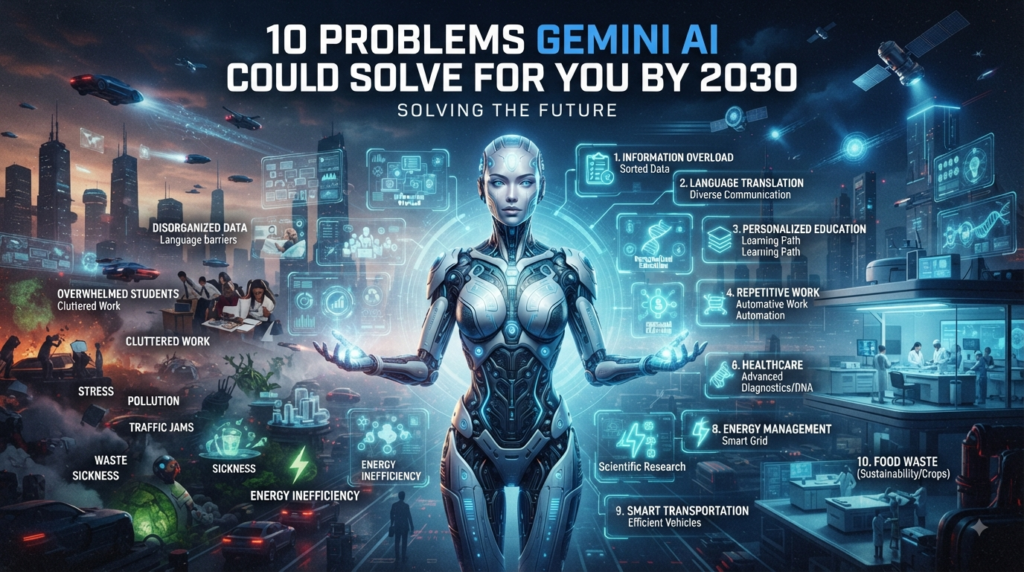
Frequently Asked Questions
1. What problems could Gemini AI solve by 2030?
Potential problems include information overload, language barriers, personalized education, repetitive work, personal planning, health-information analysis, scientific research, energy management, transportation coordination, and food/resource waste. These are possibilities rather than guaranteed capabilities.
2. Will Gemini AI replace humans by 2030?
There is no reliable basis for claiming that Gemini will replace humans broadly by 2030. A more realistic possibility is that AI will automate certain tasks and augment human workers. Jobs involving creativity, relationships, judgment, leadership, and physical-world responsibilities may continue to require substantial human involvement.
3. Could Gemini become a personal assistant by 2030?
It is possible that AI assistants could become substantially more capable of coordinating calendars, information, tasks, travel, communication, and other digital workflows. However, the exact capabilities available by 2030 cannot be known today.
4. Can AI detect diseases before doctors?
AI may potentially help medical professionals identify patterns that deserve further investigation. However, AI should not be treated as an independent replacement for medical diagnosis. Healthcare decisions require appropriate clinical oversight and professional judgment.
5. Could Gemini help students learn better?
Potentially, yes. Advanced AI could personalize explanations, adapt difficulty, generate exercises, identify weaknesses, and provide immediate feedback. The quality of learning would still depend on the accuracy of the AI and the student’s engagement.
6. Could AI solve traffic congestion completely?
Probably not completely. Traffic depends on infrastructure, population density, road design, human behavior, public transportation, construction, weather, and many other factors. AI could potentially improve coordination and reduce some inefficiencies.
7. Will AI eliminate information overload?
AI could potentially reduce the burden by filtering, summarizing, organizing, and prioritizing information. But AI also creates new information. The challenge may therefore shift from simply finding information to determining which AI-generated information deserves trust.
8. What is the biggest problem AI could solve by 2030?
There may not be one universal answer. Information management, personalized learning, scientific research, healthcare support, and workflow automation could all have significant effects. The biggest impact may come from AI’s ability to combine several capabilities rather than solving only one isolated problem.
The Bigger Picture: What Could Gemini Become by 2030?
When people discuss AI, they often focus on individual features.
Can it write?
Can it translate?
Can it create images?
Can it answer questions?
But I think the larger transformation could happen when these capabilities become connected.
Imagine asking an AI to help you accomplish a complex goal.
Instead of simply responding with information, the system could potentially understand the objective, research the relevant material, create a plan, identify obstacles, complete authorized digital tasks, monitor progress, and ask you for decisions whenever human judgment is required.
That is a different category of technology.
The important question would no longer be:
“What can AI answer?”
It would become:
“What can AI help me accomplish?”
That distinction explains why the future possibilities described in 10 Problems Gemini AI Could Solve for You by 2030 are bigger than a list of chatbot features.
Information overload is connected to decision-making.
Language translation is connected to education and business.
Personalized learning is connected to opportunity.
Automation is connected to productivity.
Scientific research is connected to medicine and energy.
Energy management is connected to sustainability.
Transportation is connected to urban life.
Food optimization is connected to resource efficiency.
The potential power of AI may come from connecting these systems together.
But greater capability also means greater responsibility.
A system powerful enough to coordinate important parts of our lives needs safeguards just as powerful as its capabilities.
Privacy must matter.
Accuracy must matter.
Human oversight must matter.
Security must matter.
And human dignity must matter.
Conclusion
The future of AI should not be measured only by how intelligent a model becomes.
It should be measured by whether that intelligence actually helps people live, learn, work, communicate, and solve problems more effectively.
By 2030, Gemini or other advanced AI systems could potentially help with 10 Problems Gemini AI Could Solve for You by 2030: information overload, language barriers, personalized learning, repetitive work, personal planning, health-information analysis, scientific research, energy management, transportation, and food/resource waste.
But none of these outcomes is guaranteed.
The most useful future is not one where humans surrender every decision to machines.
It is one where technology handles complexity while humans retain responsibility for purpose, judgment, ethics, relationships, and meaningful decisions.
That is the future worth building.
So don’t only ask what AI might do for you by 2030.
Start asking a better question today:
What problem in your life could technology help you solve more intelligently?
Learn. Experiment. Verify. Protect your information. Keep improving your skills.
And most importantly, remember that powerful technology is only valuable when it is used wisely.
“We can provide advice and practical solutions, but the final outcome is in the hands of Allah (SWT). Turn to Him, make sincere du’a, and trust His plan. With Allah’s help, every difficulty has a way forward, and every goal becomes possible.”